
Press release · 9 August 2026 · version 0.1.0-candidate
Exact Smith Invariants and Affine Determinant Lines of Binary-Form Factorisation
A candidate all-factor determinant-line theorem and exact Smith calculation replace the rank-one degree difference by a complete character-lattice invariant.
Plain-English summary
When a polynomial is presented as a product, multiplying the factors together loses information. The most obvious loss is scale: multiply one factor by a number and compensate by dividing another factor by the same number, and the product stays fixed.
The parent paper treated two factors. There is then one lost scaling direction, and a single degree difference measures whether one extra normalising coordinate restores it. This child candidate studies any number of factors. The one degree difference becomes an integer matrix of scaling weights, and its Smith normal form records the exact finite ambiguity that remains.
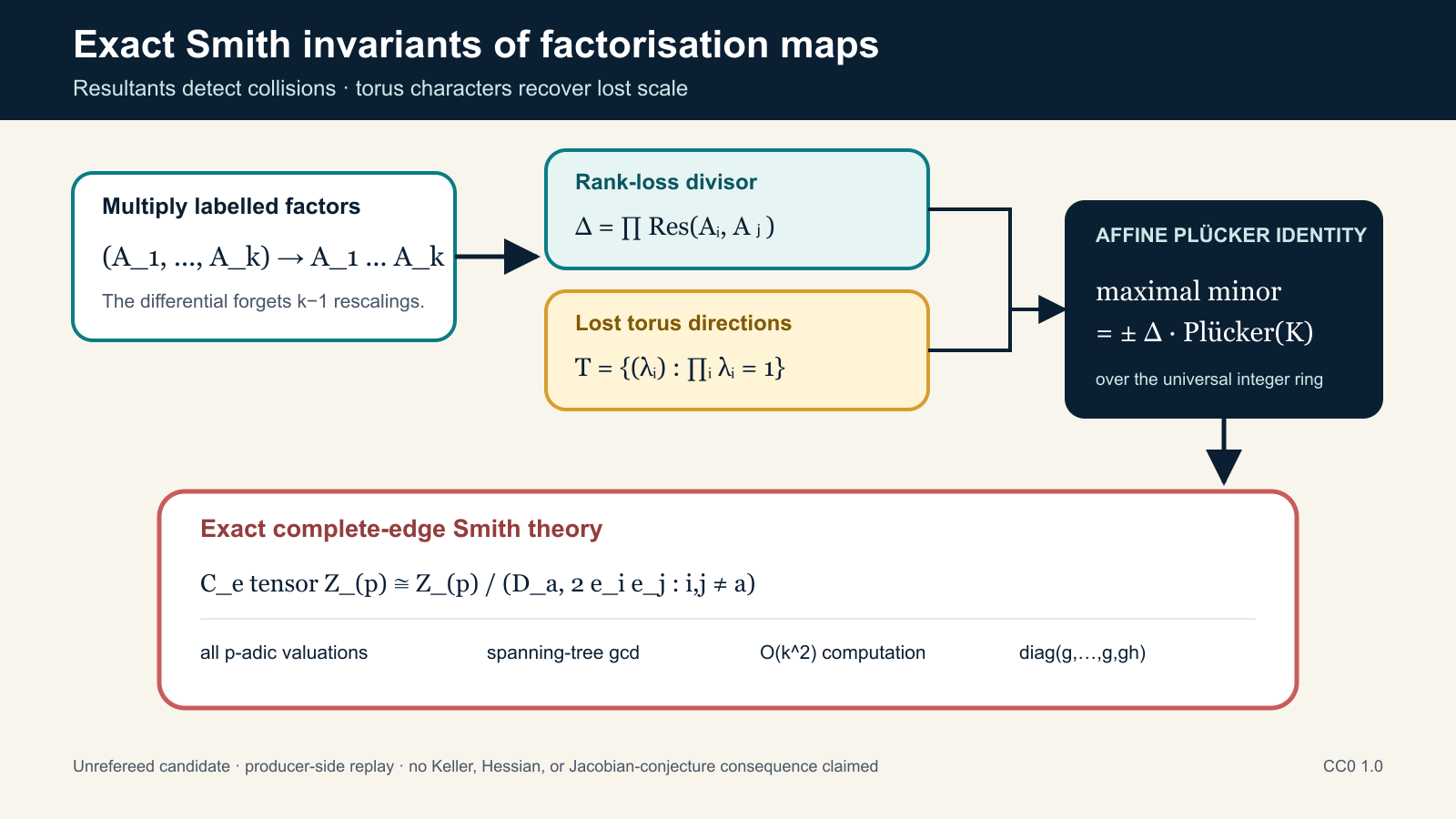
The candidate separates three layers:
- Differential geometry: the product of all pairwise resultants records where multiplication loses more rank than scaling alone explains.
- Integer arithmetic: the character matrix records how chosen resultant coordinates see the missing scaling torus.
- Global geometry: after the torus has been normalised, labelled partitions of the product's roots account for the remaining generic covering degree.
Status: anonymous, unrefereed candidate. Producer-side exact replay and public checksum readback pass. The universal theorems rest on the written proofs. No independent reproduction, proof-assistant formalization, external specialist review, editorial peer review, or absolute priority determination has occurred.
The central determinant-line statement
Let $A_i$ be binary forms of positive degrees $d_i$, let $D=\sum_i d_i$, and consider
The source has $k-1$ more dimensions than the target. On the pairwise-coprime locus, those missing directions are precisely the relative scalings
Write $K$ for a matrix of infinitesimal scaling directions and
The candidate's affine all-factor theorem says that every maximal minor of $Dm_{\mathbf d}$ is, up to one explicit orientation, $\Delta_{\mathbf d}$ times the complementary Pluecker coordinate of $K$. In exterior-algebra language, the entire top determinant line factors into
Adding $k-1$ normalising functions $g_1,\ldots,g_{k-1}$ and applying Cauchy--Binet gives
where the $\delta_b$ generate the scaling torus. If the $g_a$ are semi-invariants with integer character matrix $W$, this becomes
For two factors, $W$ is a $1\times1$ matrix. Its sole entry is the old degree difference. The parent theorem is therefore the rank-one case of the character-matrix formula.
The arithmetic heart: exact Smith data
Each pairwise resultant is a regular unit on the pairwise-coprime open set. Its scaling character gives one column in a complete-edge integer matrix. The resulting lattice controls which combinations of resultants can fix the scaling torus and which finite diagonalizable group remains.
Put $g=\gcd(d_1,\ldots,d_k)$ and write $d_i=ge_i$ with primitive degree vector $e$. If $h(e)$ is the top determinantal divisor of the primitive complete-edge character matrix, the candidate proves the global Smith form
The nontrivial assertion is that the primitive cokernel is cyclic. More strongly, for every prime $p$, choose an index $a$ for which $p\nmid e_a$. Over $\mathbb Z_{(p)}$, the cokernel has the one-generator presentation
This determines the exact $p$-adic valuation of $h(e)$, not only which primes can occur. It also recovers the parity rule at $p=2$, gives the full bad-characteristic support, and identifies the residual group scheme by Cartier duality.
The same arithmetic can be computed from spanning-tree minors alone. That bridges the result to signed-incidence and arithmetic-matroid methods while keeping the cross-weighted quotient specific to this factorisation problem.
Geometry of the normalized charts
On the squarefree locus, the projective factorisation space is a finite etale cover of coefficient space: a point amounts to partitioning the $D$ distinct roots into labelled blocks of sizes $d_1,\ldots,d_k$. Its degree is
A square character normalisation with matrix $W$ adds a torus isogeny. The candidate proves, after the required generic shrinking, a finite-locally-free degree
In positive characteristic, the Smith invariant factors of $W$ split this into separable and inseparable degrees. For the complete system of resultant units, the canonical residual group is the diagonalizable group dual to the lattice cokernel.
This does not automatically produce a Keller map on affine space. Constant Jacobian is only the local differential condition. A factorisation slice must additionally be an affine space and have the required global non-proper or multiple-fibre behaviour. That affine-slice recognition problem remains the central geometric bottleneck.
What is classical, and what is offered here
The renewed antecedent audit materially narrowed the contribution boundary. Classical and prior results already include:
- square or monic polynomial-multiplication Jacobians equal to Sylvester resultants;
- monic multi-factor coprimality and corank criteria;
- determinant products arising from polynomial Chinese-remainder maps;
- signed-incidence and frame-matroid determinant support; and
- arithmetic-matroid multiplicities as gcds of basis determinants.
The candidate does not relabel those ingredients as new. Its bounded contribution claim concerns the explicit integral non-monic affine complementary-minor tensor, its multi-border and orientation package, and especially the exact cross-weighted complete-edge Smith calculation: primitive cyclicity, the local one-generator presentation, exact valuations, spanning-tree gcd equality, scaled Smith form, and the resultant-relative group-scheme interpretation. The normalized covering degree is presented as a synthesis of classical root partitions and torus-isogeny degree.
No bounded search can establish global priority. The package records the search boundary and names the closest exact and partial antecedents.
Evidence and audit trail
The deterministic package contains a 35-page manuscript, generated TeX, 28 checked references, seven registered claims, a 96-artifact manifest, three inherited verification tiers, a new local-Smith tier, review records, and exact environment receipts.
The full replay reports:
- 129,352 positive checks across determinant, graph, Smith, valuation, local-presentation, and geometry fixtures;
- 18 deliberate negative controls, all detected;
- ordinary and optimized Python runs with matching canonical receipts;
- exact SymPy and FLINT backends for the determinant identities;
- exhaustive graph and Smith enumerations within declared bounds;
- adversarial out-of-bound fixtures and all-pivot local checks; and
- a deterministic 118-entry ZIP whose fresh extraction passed the manifest, claims, replay, receipt comparison, and manuscript build.
Finite checks cannot prove the universal theorems. Multiple implementations created inside one coordinated workflow are not unaffiliated reproductions. The proof, geometry, arithmetic-priority, citation, originality, and reproducibility reviews are producer-workflow records, not external peer review.
What the result does not establish
- It does not classify arbitrary polynomial normalisers; the canonical statement is about regular units generated by pairwise resultants on the fixed coprime open set.
- It does not show that every character-lattice basis can be represented by polynomial monomials with nonnegative exponents.
- It does not prove global finite-flatness without the stated squarefree and generic-shrinking hypotheses.
- It does not identify affine-space slices or classify factorisation-derived Keller maps.
- It does not settle the two-dimensional Jacobian conjecture or the four-dimensional Hessian frontier.
- It does not supply independent reproduction, formal verification, external specialist review, journal submission, editorial peer review, or secured novelty priority.
Relationship to the parent release
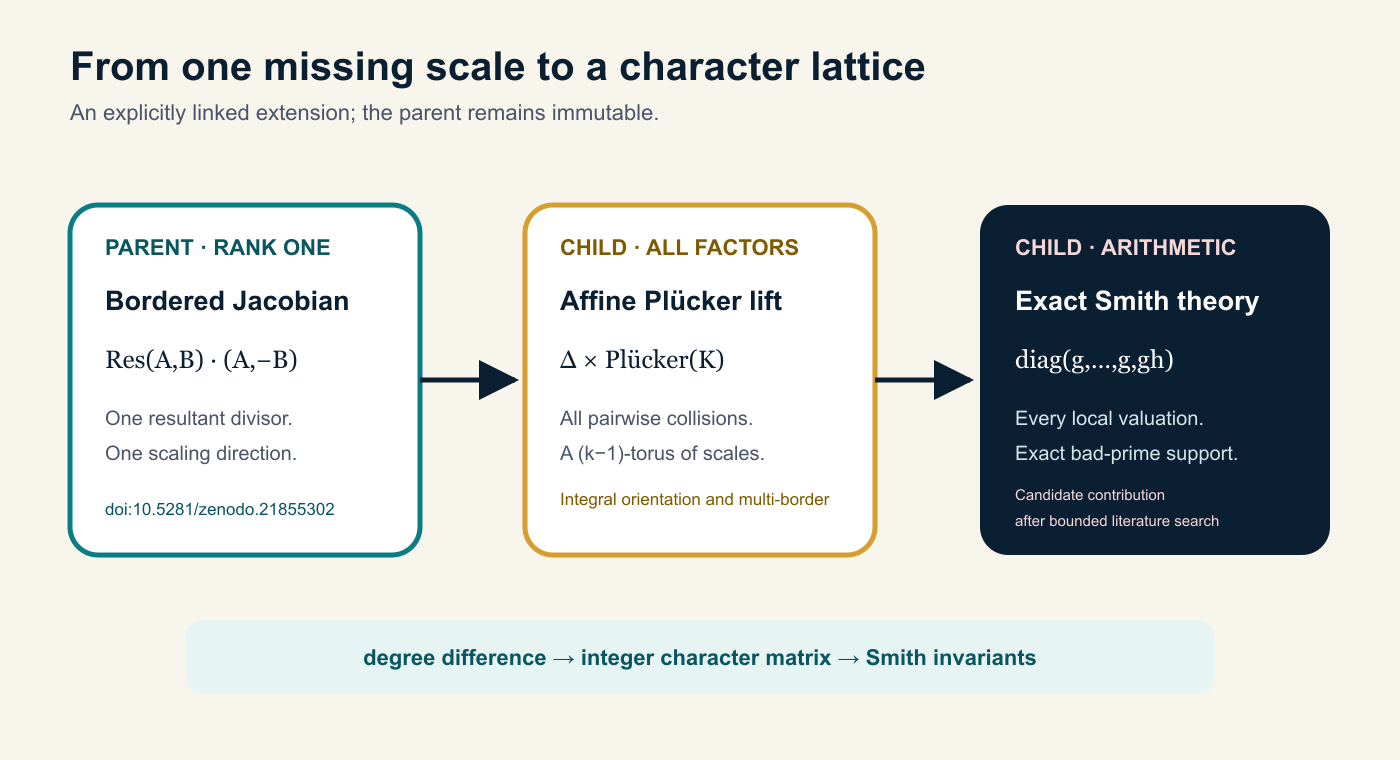
The original parent paper on Evidence Press and its immutable Zenodo archive, doi:10.5281/zenodo.21855302, remain unchanged. They establish the two-factor bordered identity and degree-difference contraction.
This child generalises the scaling kernel from one dimension to $k-1$, the scalar weight from one degree difference to an integer character matrix, and the rank-one residual arithmetic to a Smith-normal-form calculation. It is a separate publication with its own GitHub prerelease and Zenodo DOI. It is not a correction to the parent and does not retrospectively change the parent's assurance state.
Who should care, and why
| Audience | What may be useful | Highest-value next check |
|---|---|---|
| Elimination theorists | An explicit affine determinant-line lift of classical monic Jacobian-resultant identities. | Reconstruct the induction and orientation independently, and search determinant-complex literature for an equivalent tensor formula. |
| Arithmetic matroid and signed-graph researchers | A complete cross-weighted character list whose primitive cokernel is cyclic, with exact local valuations. | Recast the local presentation in arithmetic-matroid or matroid-over-$\mathbb Z$ language and test its functorial limits. |
| Algebraic geometers | A canonical unit-character residual group and a finite-locally-free normalized factorisation chart. | Audit the fpqc descent and distinguish branch-labelled, unlabelled, polynomial, and Laurent normalisations. |
| Jacobian and Keller-map researchers | A clean separation between local determinant control and the rare affine-slice problem. | Classify affine-space slices rather than treating etaleness alone as a Keller construction. |
| Formal methods researchers | Integral polynomial identities, finite graph classifications, local module elimination, and explicit base-change statements. | Formalize the determinant-line theorem and local Smith presentation with a recorded axiom footprint. |
| Reproducibility auditors | A deterministic archive, exact receipts, negative controls, fresh extraction, and public cross-channel hashes. | Rerun or reimplement the immutable package unaffiliated with the producer workflow and publish the receipt or objection. |
How to reproduce the recorded checks
Download the release ZIP and checksum ledger from GitHub or Zenodo. After verifying SHA256SUMS, extract into a fresh directory and follow the archive's README.md. The recorded full entry point is:
PYTHONDONTWRITEBYTECODE=1 python3 verification/run_all.py --root . --mode bothThe package also exposes separate manifest, claim-registry, receipt-comparison, archive-build, and fresh-extraction interfaces. Use Python 3.13 with the recorded SymPy, python-flint, and jsonschema versions for same-environment replay. A successful rerun supports package integrity and implementation behaviour; it does not by itself independently prove the general theorems.
The most valuable next projects
- Complete an unaffiliated proof reconstruction and exact reimplementation.
- Formalize the determinant-line and local Smith theorems.
- Classify all regular-unit and polynomial normalisers.
- Recognize or obstruct affine-space slices using affine geometry, not determinant calculus alone.
- Test whether the known three-dimensional factorisation mechanism is unique within a carefully stated architecture.
- Prove a construction or no-go theorem for the four-dimensional Hessian frontier only after the slice and symplectic constraints are made explicit.
What is in the public package
- the 35-page manuscript, Markdown source, generated TeX, and bibliography;
- the deterministic release ZIP and complete SHA-256 ledger;
- exact SymPy, FLINT, graph, Smith, valuation, and geometry verification scripts;
- ordinary and optimized receipts plus deliberate negative controls;
- manifest, claims, status, assurance, provenance, environment, and licensing records;
- antecedent, citation, originality, proof, arithmetic, geometry, and reproducibility audits;
- a hardened fresh-extraction verifier and its external receipt;
- the visual abstract, lineage graphic, and plain-English audio summary with transcript.
Original non-code content is dedicated to the public domain under CC0 1.0; original code is MIT. Scholarly attribution is Anonymous. Operational maintenance and publication roles are recorded in the machine-readable provenance. The audio voice is AI-generated and is not mathematical evidence.
Searchable mathematical objects
Exact text is provided alongside typeset mathematics so people and automated research tools can find and compare the objects without inferring a stronger assurance state.
All-factor bordered Jacobian determinant
- Exact searchable text
det D(m_d,g_1,...,g_(k-1)) = +/- Delta_d det(delta_b g_a)- LaTeX
\det D(m_{\mathbf d},g_1,\ldots,g_{k-1})=\pm\Delta_{\mathbf d}\det(\delta_b g_a)- Object type
- identity
- Relation to release
- claimed-result
- Scope
- Universal multi-border determinant identity asserted by the anonymous unrefereed candidate; exact replay checks examples and structural consequences but does not replace independent proof review.
Labelled root-partition degree
- Exact searchable text
nu = D! / product_i(d_i!) where D = sum_i d_i- LaTeX
\nu=\frac{D!}{\prod_i d_i!},\qquad D=\sum_i d_i- Object type
- formula
- Relation to release
- supporting-result
- Scope
- Multinomial root-partition factor in the release's finite-locally-free degree formula, under its stated generic and normalisation hypotheses.
Media
The audio briefing is provided in the header above. Download the MP3 briefing · read the transcript.
Open directions for follow-up research
Also available in machine-readable form for research agents and follow-up projects.
- Obtain an unaffiliated reconstruction of the all-factor affine maximal-minor theorem, including its integral orientation and multiplicity-one statement.
- Reimplement the complete-edge local Smith presentation and valuation formula in a fresh exact system and compare the resulting group schemes prime by prime.
- Formalize the determinant-line induction, graph-minor classification, local module presentation, and finite-locally-free descent in Lean or another proof assistant.
- Extend the bounded antecedent audit across determinant complexes, Hensel lifting, signed and gain graphs, arithmetic matroids, toric arrangements, non-English literature, and theses.
- Classify all regular-unit and polynomial normalisers on the pairwise-coprime locus, beyond semi-invariant and Laurent resultant coordinates.
- Determine which normalized target slices have affine-space inverse images and whether the known three-dimensional Keller mechanism is isolated inside this architecture.
- Seek either a construction or a no-go theorem connecting factorisation-derived maps with the unresolved four-dimensional Hessian frontier, without treating the determinant identity alone as evidence for such a connection.
Verification status
Anonymous, unrefereed candidate mathematical release. Availability, deterministic packaging, public checksum readback, and producer-side exact replay pass. The packaged evidence reports 129,352 positive checks and 18 detected negative controls in the recorded Python 3.13.5 environment. The main all-factor, Smith, and geometric assertions are universal mathematical theorems supported by prose proofs, not established by finite computation alone. The antecedent audit found classical monic and square Jacobian-resultant identities, multi-factor coprimality criteria, signed-incidence methods, and arithmetic-matroid multiplicity frameworks; it did not locate the complete affine Pluecker tensor or the exact cross-weighted local Smith presentation in its bounded search. No unaffiliated rerun, independent reimplementation, proof-assistant formalization, external specialist review, editorial peer review, or absolute priority determination is claimed.
Cite
BibTeX
@misc{exactsmithinvariantsaffinedeterminantlines2026,
  title        = {Exact Smith Invariants and Affine Determinant Lines of Binary-Form Factorisation},
  author       = {Anonymous},
  year         = {2026},
  doi          = {10.5281/zenodo.21861347},
  url          = {https://doi.org/10.5281/zenodo.21861347},
  version      = {0.1.0-candidate},
  howpublished = {Zenodo},
  note         = {Unrefereed; internally replayed evidence package. Press page: https://evidencepress.org/releases/exact-smith-invariants-affine-determinant-lines/}
}Also: cite.bib · paper.json · this page as Markdown