Productivity Protocols · case study
One Person, a Whole Press
A publisher, a research group and a film studio with one person behind it: a running benchmark of what is becoming possible with AI.
Evidence Press is an experiment run in public: what can one person do with today's AI? It is a publisher, a research group, a film studio and a bookshop, and it has one person behind it, working with AI systems, mainly Anthropic's Claude and OpenAI's models. Everything it makes is published and dated, so it doubles as a running benchmark of what is becoming possible.
What the work is
Most of it is new mathematics, released with the data and code needed to check it, and explained in plain-English films. A few of the results:
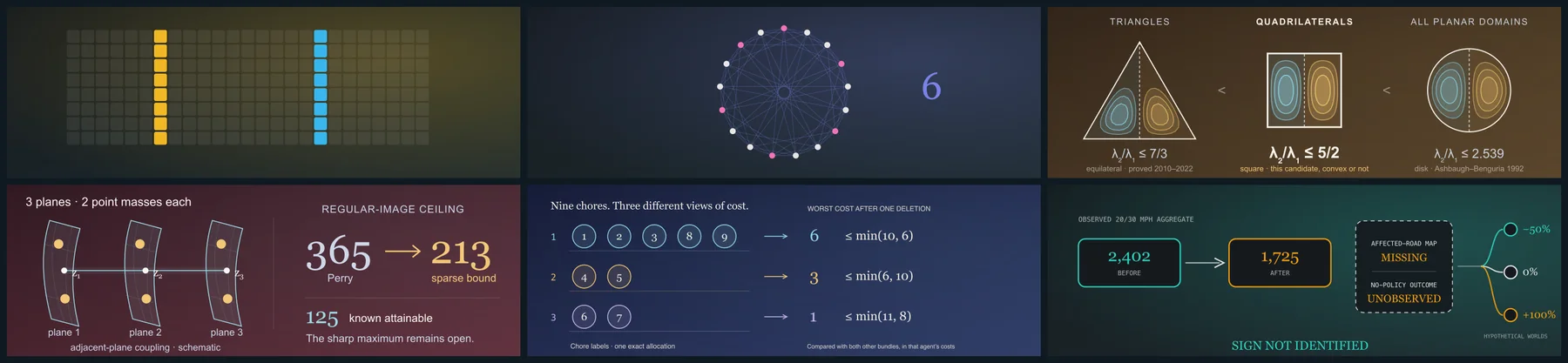
- An Erdős problem, answered for every number. Paul Erdős and András Sárközy asked how many whole numbers up to N can be chosen so that multiplying any two of them and adding one never gives a squarefree number. Earlier work had settled it for very large N. In its first week, Evidence Press published the exact answer for every N.
- The first open case of another. Erdős problem 758 asks how few groups any network can be split into, if each group must be either fully connected or not connected at all. For 20 points the answer was known to be 6 or 7. Evidence Press showed it is 6, with the computer part checked by four independent checkers, one of them formally verified.
- The best four-sided drum. Among all drums shaped like a four-sided figure, the square holds its two lowest notes furthest apart: the four-sided case of a conjecture about which shapes do this best.
- How many times can one galaxy appear? A massive object between us and a distant galaxy bends its light into several images. For a lens made of two pairs of stars at different distances, Evidence Press lowered the proven maximum from 41 images to 33.
- Sharing chores fairly. Any nine chores can be divided among three people so that nobody would rather have someone else's share once a single chore is taken off their own list, however differently they rate the chores.
- A public question. Casualties on Welsh roads fell by 28% in the first year of the 20 mph limit. Evidence Press showed what the published figures can and cannot tell us about how much of that fall the policy caused.
Alongside the research come long-form articles that examine the biggest AI news as it breaks, from OpenAI's claimed resolution of a Millennium Prize Problem to what is really inside a neural network, and a book of 100 puzzles, Think Again.
Why it matters
Mathematics is where the effect of AI shows earliest and most clearly, because a proof can be checked. If one person can now produce research of this kind at volume, the same shift is coming to any work whose output can be checked: analysis, software, reports, design. Evidence Press makes that shift visible, in public, as it happens.
How it compares
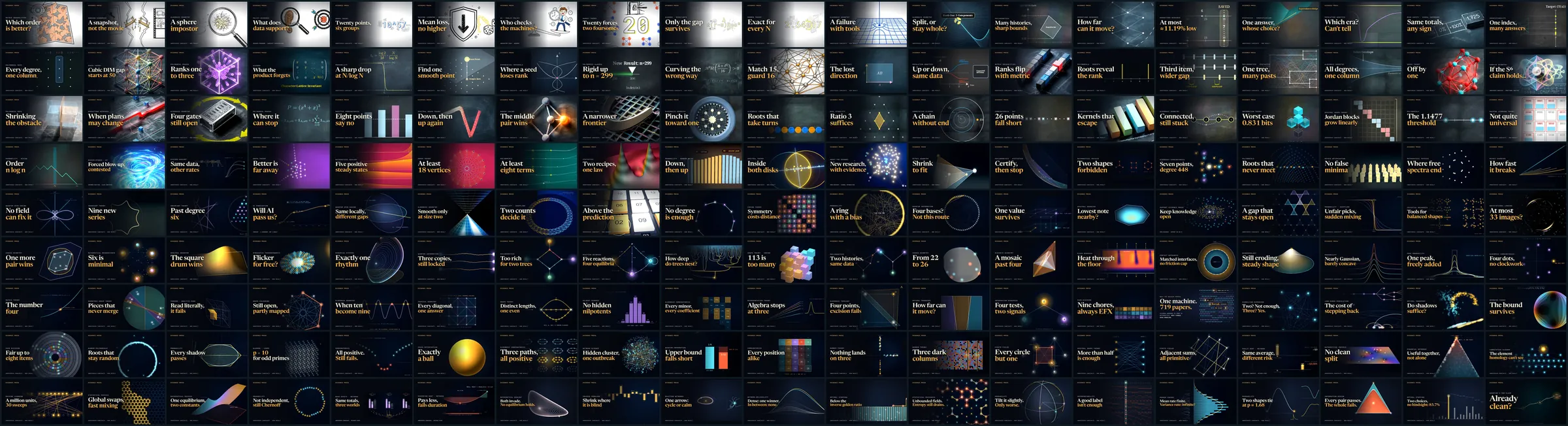
In its first twelve weeks, from 28 July to 20 October 2026, Evidence Press published:
- 169 research results, each with a DOI, its data and code;
- seven long-form articles, each with a full narrated version;
- 171 explanatory films and 127 short videos;
- a book, in hardback and Kindle editions.
For comparison, a classic study of scientific careers found that researchers typically first-author a handful of papers, often between three and six, in the first fifteen years of their careers (Fanelli and Larivière, 2016). Each result is narrower than a typical paper, but the difference in scale is more than a hundredfold, from one person, for about $500 a month.
Where AI is heading
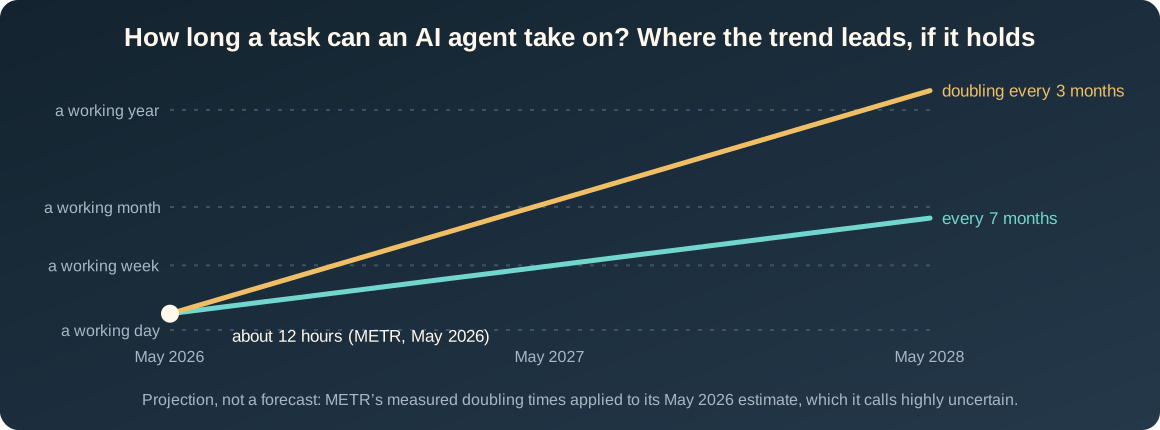
Evidence Press is possible because of a change that is still accelerating. For six years, the length of task an AI agent can complete on its own, measured by how long the same task takes a skilled person, doubled about every seven months; since 2024 it has been doubling roughly every three (METR, 2025 and 2026). By May 2026 METR put the public frontier at about twelve hours of skilled human work, with the most capable models it had examined beyond two full working days, while warning that its tests can no longer measure reliably above sixteen hours and that its estimates are highly uncertain (METR, 2026). Over the same period the price of a given level of capability has fallen between nine and nine hundred times a year, depending on the task (Epoch AI, 2025).
The second change is from one assistant to fleets. A team of AI agents, one directing and others searching in parallel, outperformed a single agent by 90% on Anthropic's research tasks, at around fifteen times the computing cost (Anthropic, 2025). In February 2026 Anthropic described sixteen agents working for two weeks, for under $20,000, to write a 100,000-line C compiler able to build the Linux kernel (Anthropic, 2026). In September 2026 OpenAI reported a fleet of about 10,000 agents working for 88 hours on the Navier–Stokes problem, one of the Clay Millennium Prize Problems (Evidence Press commentary).
Evidence Press works at the small end of this: one person directing a handful of agents at a time, such as three fact-checkers in parallel or a dozen film-makers. Even so, its research output rose from about eight results a week in its first month to thirty by mid-October. If the trend holds even in part, one person directing a fleet will be able to take on projects that today need a department. What it does not remove are the constraints Evidence Press already meets: deciding what is worth doing, checking that results are right, and earning the attention and trust of the people they are for.
What it means for productivity growth
Output per hour in the UK grew by about 2% a year in the decade before 2008, and by only about 0.3% a year in the decade after (ONS, 2020). Forecasts of what AI will do range widely: from a total gain in productivity of no more than 0.66% over ten years (Acemoglu, 2025), through about 0.2 percentage points a year for the UK by the end of the decade (Office for Budget Responsibility, November 2025), to 1.5 percentage points a year in the United States (Goldman Sachs, 2023).
The gap between those forecasts is mostly about how fast and how far AI spreads into ordinary work. Controlled studies already show large gains on particular tasks: customer-support agents resolving 15% more issues an hour, and about 30% more for the least experienced (Brynjolfsson, Li and Raymond, 2025). They also show losses: experienced programmers working on their own code took 19% longer with AI, while believing it had made them faster (METR, 2025).
Evidence Press shows what the upper end can look like when the work is reorganised around AI rather than added to the old way of working. That is why this programme publishes its methods and a self-test: economy-wide growth comes from many people finding which of their own tasks gain, not from one showcase.
Is a one-person company in sight?
Sam Altman has described a betting pool among technology leaders on the first year there will be a one-person billion-dollar company (reported in 2024). Asked when the first billion-dollar company with a single employee would appear, Anthropic's Dario Amodei reportedly answered "2026" (May 2025).
On the production side, Evidence Press shows the answer is already yes: one person can now run what used to need an institution. The next frontier is the business side, reaching readers and turning output into income, and Evidence Press has just begun on it, with a shop, a book and its first funding applications.
One morning
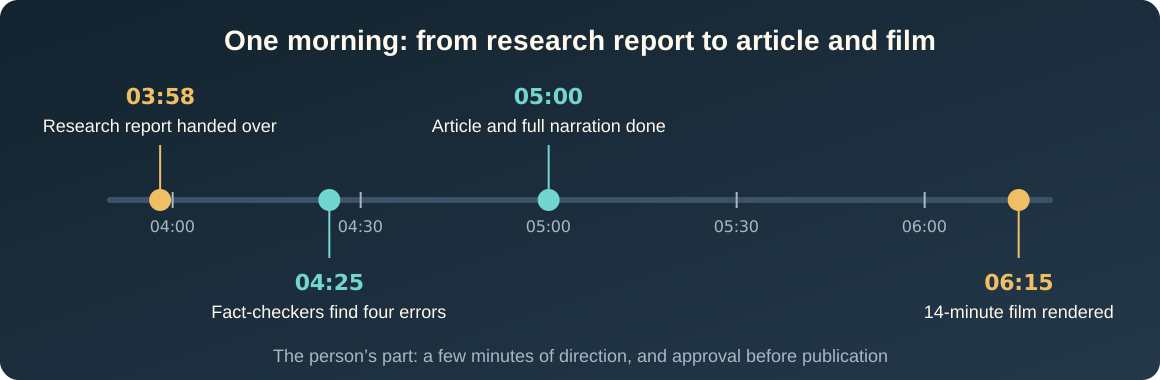
On 20 October 2026, a little before 4 a.m., the AI was handed a finished research report on a disputed claim about how AI models work, and asked to turn it into a public article. Three AI agents checked every claim against the original sources in parallel and found four errors to fix by 4:25. By 5:00 the article was written and a full narrated reading recorded and checked word for word. It went live once the person approved it. By 6:15 a 14-minute explanatory film had been scripted, reviewed by a second AI model looking for mistakes (it found one: a number read out ten thousand times too large), narrated, animated and rendered. The person's part was a few minutes of direction and approval.
Six habits anyone can borrow
- Hand over whole jobs, not single questions. Describe the result and the limits, and let the AI work through the steps.
- Run several AI workers at once. Three fact-checkers in parallel take the time of one.
- Make one AI check another. A second model told to find mistakes catches the confident slip a tired person misses.
- Turn every repeated job into a recipe. The first attempt is slow; the written method makes the next one quick. The six habits each come with a starter to copy.
- Keep a notebook the AI reads. Decisions and lessons written down once are never explained twice.
- Keep the decisions human. The person chooses what is worth doing, approves what goes out and answers for it.
What comes next
The tools will keep getting better, and the gains will go to the people and organisations that learn to direct them. The quickest way to find out what that means for a particular job is to try it: pick a recurring task, use one of the methods, and measure the difference with the two-week self-test.